


What is Noir? The nighttime, the darkness, applied to themes that are opaque, pervasive and terrifying. The detective creeps alone through the shadows, wears a trench coat, chain-smokes. The night becomes his companion, or his curse. He knows it well, but never enough. He’s annoyed by it all, but relishes it at the same time. Dread and temptation.
I guess that more or less describes classical noir. Today, there’s neo-noir. Classical noir, essentially, for modern sensibilities. Less about smoke and shadow, more explicit, innuendos brought to the surface.
The 21st century French writer Nicolas Mathieu does something different altogether. His first novel, Aux animaux la guerre (translated into English by Sam Taylor as Of Fangs and Talons),1 follows the template insofar as it’s about despair and desperation, addiction and survival (but survival for what is the question; existential themes abound, unsurprisingly for a French novelist) but instead of fixing the drama around a whodunit, he reveals the system that shaped the characters. That’s where it is less like Raymond Chandler and more like Steinbeck.
I see something of Stephen King in Mathieu as well. The Body, better known for its Rob Reiner-directed adaptation, Stand By Me. Four twelve-year-olds on the cusp of adolescence, when they must go in different directions. Different classes, different levels. The one who is hopeless of the future, the one with a bad reputation but a vastly under-appreciated heart, the one who gets picked on mercilessly and never wants to grow up, and the one who seems to have the brightest future but dreads leaving them all behind. These are the ones perhaps most vulnerable to the vices of life.
Mathieu writes, in his third novel, Connemara:
“Adolescence is premeditated murder, planned long in advance, and the body of their family as it used to be already lies dead by the side of the road. Now they must reinvent roles, accept new distances, to deal with the horror and the sudden kicks. The body is still warm. It twitches. But what used to exist—childhood and its tender moments, the unquestioned reign of adults with the kid at its center, cocooned and protected, vacations … and family Sundays at home—all of this has died.”2
His second and most renowned novel, Leurs enfants après eux (translated into English by William Rodarmor, as And Their Children After Them), isn’t so much about crime at all as it’s about the kids who are likeliest to get mixed up in it, and why. It’s a coming-of-age saga about teens who live in the Vosges mountains of northeastern France, who were born in the late 1970s, and lived through adolescence in the 1990s. The author’s lived experience unfolded in the same region and on the same timeline. He, like his characters, navigated the tough breaks of a life where nothing comes easy. His prose lingers on the pervasive myth that hard work is enough. It’s not. We see again and again that too often only the ruthless make it to the top and at terrible cost.
The novel Leurs enfants après eux won France’s prestigious Prix Goncourt in 2018, and the English translation won the Franco-American Albertine Prize in 2021.
The third novel, Connemara, the one I’m currently revisiting, is about the kind of crime that is technically legal, or at least hiding in plain sight, amid flowcharts and fine print. It’s about the kind of corporate insanity that promises dreams but wastes lives. Its own kind of systematic quagmire that no one can beat — not honestly, anyway. He stretches the wheelhouse. We’re not dealing with mafia and gangs anymore. Here it’s all about the lie that capitalism rewards virtue or even merit. No wonder there’s a rumor in the French media that he’s a socialist. But it’s not that simple. He doesn’t find the State to be a haven of virtue either. Both fascism and socialism have their traps.
Essentially, Mathieu doesn’t just write about crime. He writes about the conditions that motivate it. In the first novel, Aux animaux la guerre/Of Fangs and Talons, a factory closes, livelihoods fall apart, a union collapses. In Leurs enfants après eux, Mathieu was inspired by the biblical verse Sirach 44:93 —
“There are some of whom there is no more memory,
They perished as though they had never existed;
They became as though they had never been born,
And so did their children after them.”
Unlike the illustrious men singled out for praise in Sirach 44:1, the “they” in 44:9 are comparable to Mathieu’s characters—the ignored children, the forgotten forebears. No one hears them when they cry, and so it was for those before, and so it will be for those after. Unless there is a collective shift in consciousness, powerful and widespread enough to change human experience.
Connemara4 deals with the ambitions of those children, and the consequences of getting what they want through a selfish social class and a ruthless economy, and the fallout from reversal of fortune. It deals with nostalgia — looking back to what was left behind or lost as relief from one’s problems now.
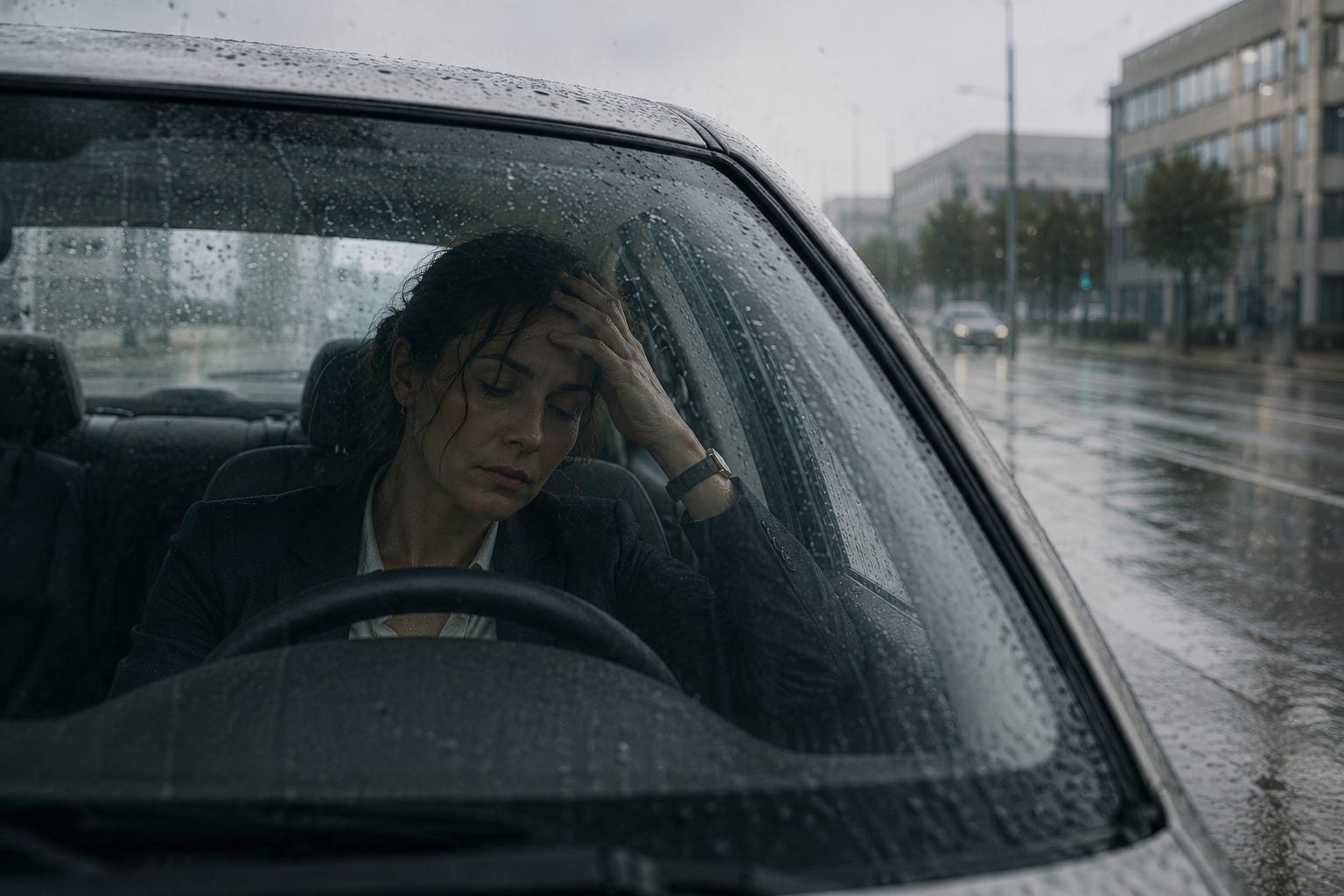
We first meet Hélène as she lies in bed with her husband, Philippe. With him asleep, she thinks of what she has to wake up and do, the routines, the responsibilities. Get the children to school, do her makeup for work in the car. She thinks of how disappointing everything is. The ennui fills her with disgust. The one thing that motivates her is the thought of meeting Manuel later — a man she’s been interacting with by text ever since they met on Tinder. We see her in work mode later, cold and cynical, forcing herself into a hopeful state of mind. She thinks of the promotion she could finally achieve if she closes on a deal her company is desperate to make with the mayor’s office. And when that deal is sabotaged by a couple of complacent bureaucrats whose only ambition is to maintain the status quo, Mathieu shows us the effects of the humiliation on her body — the heat, the sweat. Anger, frustration, terror. All exhibited in biological response. The relief also comes through the pleasure of the body. She masturbates in the parked car during a torrential rain. A solitary act, hiding in plain sight, aided in its concealment by the rainwater washing over the car.
Her bitterness is over the pointlessness of the whole system. The consulting company she works for endeavors to streamline the expenditure of the mayor’s office, but cuckolded (yes, that’s Mathieu’s analogy)5 by a stagnant bureaucracy that clings tenaciously to the flawed but functional architecture that sustains it. One office holding warring factions — those for change and those who have built their lives around the tolerance of its mediocrity.
The whole episode illustrates how even the relatively powerless, like the functionaries who impede Hélène, manage to manipulate the levers of power.
When we meet Christoph, we see him in action as a dog-food salesman. We learn of his past through the mayor himself, who won’t stop reminding Christoph of his lost glory as a hockey celebrity.
Hélène was a nobody when Christoph was glorified. Now Christoph is the “nobody,” while Hélène got everything she dreamed of, only to find that her dream was all based on a fairy tale. The illusion, the mirage of it. The promise of riches but only if you’re willing to go all the way and lose yourself completely.
There is a striking moment in the interaction between the mayor and Christoph: Christoph is there to deliver dog food. He needs the mayor to sign for the receipt. The mayor asks him to bend down so he can use Christoph’s back as a writing surface. Mathieu uses it to highlight the inequality between them, the power imbalance. Christoph doesn’t like it, but he puts up with it because it’s his job to please the clients. The mayor is aware of Christoph’s dependence. He presses the pen especially hard as he dots the i or crosses the t, producing two sharp sensations “that stung”6 Christoph’s spine. And as Christoph feels the stings, he notices one of the dogs looking at him. There is a silent communication between the dog and Christoph. Two dependent creatures, caught in a social system where importance is determined by cultural norms. Christoph sees cuteness. The dog seems to recognize a sympathetic soul. It’s a scene where humiliation is countered by sweetness.
By now we’ve seen Hélène’s response to corporate humiliation, how the body copes, and Christoph’s response to class humiliation, not internalizing it but letting his attention shift to something else. Dogs, his child, his friends.
Connemara alternates between Hélène and Christoph, their present tense and their memories. What links them is the same small town. She got out via the Bac, university, and Paris. She married well and played the game competently until she suffered a nervous breakdown. She and her family relocated back to the Grand Est region, settling in a designer house in Nancy, able to live well and at a less expense than in Paris. As if we can find wellbeing simply by rearranging external reality. Her external reality doesn’t even shift quite enough, it seems. She’s still working in the same soul-crushing industry of corporate consulting.
Christoph never had Hélène’s ambition to get out or get away. He was ambitious as a hockey player, but now that that’s over, he seems resigned to his life selling dog food — the dullness of traveling by car for sales and deliveries, gaining weight from too much reliance on convenient meals at all-night diners. While we can’t describe him as happy, he seems to find enough satisfaction in fatherhood and time with his two best friends. Things only begin to crack when his son’s mother announces that she’s going to live in another place to take a job that promises a better life for her and their son.
Mathieu gives us variety and contrast. Hélène was desperate in adolescence to get away, then resolved to return (sort of) when the Parisian life became unendurable. Christoph was motivated to be a big hockey star mainly so he could impress Charley, eventually the mother of his son. But when his hockey career fell apart, he seemed content to stay it out and accept his fate — and with a surprisingly decent attitude. We see the opposite reaction from both of his parents and his elder brother, none of whom was able to cope well with lost or denied opportunities. How well one person copes with disappointment or failure may be judged differently. You may, for instance, think Christoph drank too much beer and wasted too much of his time in the company of friends who encouraged bad habits. In general, though, you could say something like that about all of us and, frankly, all things considered, Christoph really doesn’t do too badly. He shows up to work on time, he does his job to the best of his ability. He gets his son to school, feeds him, takes care of him, loves him, plays with him, addresses him as Sweetie.
Hélène and Philippe pay a nanny to look after the kids when they’re at work. The few glimpses we see of her as a parent reveal how fed up she is, her impatience, her lack of resilience. She’s not a bad person. She reminds me of lots of people who don’t cope well when things fall short of expectation. She’s looking for happiness at little cost, a low risk escape. Some form of relief that creates the minimal disruption and discomfort.
For Hélène, Christoph represents the aspiration and the dreams she had as a teenager. When she was a teenager, she longed for the freedom of adulthood, but now she looks back on it and sees only the euphoria she felt from the dream. For Christoph, the affair with Hélène is attractive because it renews, if only for a split second, the rush of being desired again. He’s the handsome, athletic, celebrated hockey player in her eyes. One gets the feeling that both would like to have more than this — more than clandestine meet-ups in seedy hotels, far from acquaintances who might recognize them — but “more” never comes without risk. Commitment requires you to make hard choices.
The easy compensations, the difficult choices we avoid, are not so different from the smoke and shadows of classical noir. Both require lies and deception. Lying to ourselves, lying to others about who we really are. Classical noir imagined corruption hidden beneath society. Mathieu suggests corruption is laced into the structure of society itself, embedded in routines, aspirations, clichés, and the inherited wisdom people rarely stop to question.
The shadows are no longer in alleyways. They’re in office parks, consulting firms, exhausted marriages, regional decline, and the quiet humiliations people absorb into their bodies every day. We don’t need supernatural monsters or cinematic villains to show us what corrodes human beings. Often the real horror is quieter than that, folded into routines and compromises so ordinary we stop noticing them. The entertainment industry anesthetizes it for us, teaches us to make darkness stylish or dismissible. Mathieu asks us to look at it directly instead. That may be uncomfortable, but perhaps that discomfort is also a form of courage.
Notes
For those who might not know French, the English-language edition uses the title Of Fangs and Talons, which differs significantly from the original French. A more literal rendering of Aux animaux la guerre would sound awkward in English (‘To Animals, War’), which likely explains the choice for the adaptation.
Mathieu, N. (2023, p.263). Connemara (S. Taylor, Trans.). Other Press. (Original work published 2022).
The connection to Sirach 44 is discussed by Pierre Assouline in La République des livres (8 November 2018), and has since become central to many readings of the novel.
Connemara is not named after the region in Ireland directly, but after the Michel Sardou song “Les Lacs du Connemara,” a cultural touchstone in France associated with celebration, nostalgia, intoxication, aspiration, and collective memory. The title becomes deeply ironic in the context of the novel. This is also noted on English and French Wikipedia (pages for the novel) with sources, one of which is The New York Times. Gift link.
More accurately, the reference is p.149 (see second note above): “…the reflexes of a poor person, a sort of cuckold’s instinct that enabled her to see straight through the stupidity of vertical orders, the fundamental mismatch between the good intentions of elegant people and the heavy desires of average lives.”
Connemara, p.34.