


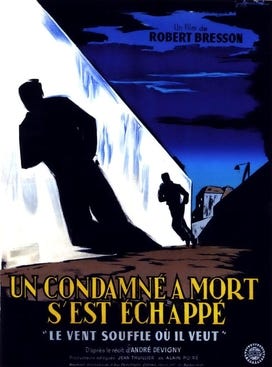
“The wind bloweth where it listeth, and thou hearest the sound thereof, but canst not tell whence it cometh, and whither it goeth….”
John 3:8 (King James Bible)
You might think, with a title like that, don’t we already know what happens? Is the spoiler baked into the title? In a sense, yes. If all you care about is knowing the ending, it might not be a movie you want to see. But let’s separate that idea for a moment: only knowing the ending. Nothing else. You only know the ending. You don’t know how you got there. You don’t know what you had to become to arrive. A Man Escaped is a film full of metaphors about failing and trying again, about focus, about determination—to survive, to be free. The escape is only the end. The film is everything that made it happen. The film is everything that almost happened. It’s every hesitation. It’s every moment when he had to stop his work for fear of being caught. It’s the moment he took an incredible risk to preserve the part inside himself that could still feel pride: in my opinion, that’s what the pencil was about. (A pencil he still needed, though giving it up would have been the safer choice. But choosing to keep it, he turned it into a quiet act of defiance.) Yes, this film is an inventory of ordinary objects, repurposed by Fontaine, a Resistance prisoner of the Germans in occupied France, for his goal of escape. A safety pin to remove handcuffs. A spoon he surreptitiously withholds while returning the tin out of which he consumed his daily ration of food, to chisel away at the joints in the wooden door. Wire from the bed frame. Braided linens to make a rope. But it’s not only inanimate, mundane objects that he makes use of. He communicates with fellow prisoners, who share his desire for escape but may not want to risk it themselves. They like the idea that someone could, better that someone would escape, because it means that, somehow, in the fight against the enemy, hope is still warranted. As long as escape remains possible, there is no need to think of giving up. That’s the philosophical justification to watch the movie. The cinematic perspective is about how silence and sound overtake the unseen and what the director, Robert Bresson, chose to make unseen. We don’t see any violence, but you know it’s there. Pay attention to the seen and unseen, like the prisoner in the next cell Fontaine never sees but still knows is there by the tapping rhythm they use to communicate. The door with the hole. The towel over the hole. Fontaine looks through the hole at the door opposite his cell. It has the same hole, suddenly revealed--by what, we don’t see, but we infer it’s the removal of what the prisoner inside that cell uses to cover it, and uncover when he wants to look back across the hallway at Fontaine’s door. Hole covered, hole uncovered. There’s a third channel through which to think about this film. I don’t have a name for it. There’s a heroic element in the story. The other prisoners admire Fontaine, are jealous perhaps, but mostly just awe-inspired. Because they are scared. Terrified. And they know he’s scared too, but doing it anyway. They want him to succeed. They want escape to be possible. I felt it too--wanting him to succeed because that means, in the worst circumstances, I can still find a way; I can still be ok. One has the same feeling when watching a superhero film. There’s still a chance. The good guy can still win. The bad guy can still be defeated. As long as hope exists, freedom is still worth the effort. Batman is only a man who masters technology and invents tools against his enemies. Spider-Man needs special effects to swing through the air. Bresson needs none of that to make Fontaine heroic. He only has to show him doing what seems impossible with a spoon, some wire, torn cloth, patience, and nerve. And crucially, we see Fontaine frightened. That increases rather than diminishes the heroic effect. Because if Fontaine were fearless, he would be different from us. Seeing that he is afraid and acts anyway turns hope to a higher frequency. The heart beats a little faster. Maybe the impossible is not impossible after all.
So, no, this is so much more than a story with a spoiler baked in the title. It’s a true story about a real French Army lieutenant in occupied France during World War II, André Devigny. It’s a story about a man who kept trying when he could have been forgiven for giving up. He was terrified, but did the “crazy thing” anyway. But the chance at freedom was worth the effort. That’s the dream, right? If there’s any chance, any hope at all, we can dare, we can try. “A Man Escaped” is exactly what we can imagine Fontaine becoming to the prisoners he left behind. To them, he was the man who got out. He did it. It’s possible. There’s still reason to hope.
And then Fontaine’s companion, Jost, once they are free, says, “If my mother could see me now.”
After everything, that is what remains: not triumph in the abstract, but the intensely human wish to have done something that would make one’s mother proud. Is there any feeling superior?